From Constant Rebuilding to Building Stronger
How The Gogan Team Went From Overtraining to Building Stronger
Table of Contents
Meet Claire Gogan: A Team Leader Who Measures Success Differently
Claire Gogan leads one of the most productive teams in her market on a per-agent basis. She’s a leader known not to settle just because the numbers look good, but to build a strong organization designed to support everyone in it.
Committed to growing her people, she wasn’t under-training her agents. If anything, she was over-training. Four to five days per week of sessions, leadership pouring in time, but without the consistent results and skills landing the way she wanted.
She’d reached the point where many would default to what most team leaders do: add salaried trainers, hire more staff, throw more people at the problem. But she could see the real issue wasn’t capacity. The team didn’t yet have the right system in place, which meant throwing more coaching calls or more people at it would only compound the problem. So instead of reaching for a band-aid, she chose to go straight to the root and rebuild, using the Agent Development Team system.
What changed wasn’t just their schedule or how their resources were allocated. It opened up an entirely new pathway, one where structure and streamlining became the engine for growing her team rather than the thing holding it back.
Before: Training Hard, But Not Landing
Claire’s team wasn’t under-investing in training. If anything, they were over-investing. Claire and her Sales Manager, Delaney Duncan, explained that they were training four to five days a week. Agents came in for sessions, and leadership poured time into it. But the structure and framework they knew they were teaching wasn’t coming through clearly in the way they were teaching it.
There were no real checks and balances, no checkpoints to confirm an agent had actually met a performance standard before moving on. Agents advanced through the material without anyone verifying the skill had landed.
The knowledge was there. The application, training, and growth system wasn’t.
The shift was dramatic. They went from four to five days down to one full-on, high-impact training day per week. With clear outcomes and objectives for each session, everyone involved accomplished more in less time, which freed up real bandwidth for agents and leadership.
Especially Monday, it's one super impactful day. It makes it much easier for people to come in and commit to that afternoon, and that has really helped.
It freed up leadership too.
Especially Monday, it's one super impactful day. It makes it much easier for people to come in and commit to that afternoon, and that has really helped.
What the Old Way Was Costing Them
The first cost was time. Time, and the resources behind it. Claire and Delaney had reached the point of needing to hire another person to keep up, yet all that investment still wasn’t producing the results they wanted.
Even with all that time and resource poured in, the old way was ultimately costing them results for their agents. As experienced leaders, both Claire and Delaney have a great deal of expertise to share. But the system they were using wasn’t transferring that capability to their agents consistently or reliably.
Every agent who attended without truly absorbing a skill was a missed opportunity: a conversation that could have closed, a client who could have been served better, growth left on the table. The old approach ran on learning by failing. Lots of critique, lots of feedback, lots of reiterating, all happening late.
There was a lot more learning by failing and critique and feedback and then reiterating. Now we're getting ahead of more of that, or they're failing earlier on. They can adapt more. They understand how to do that and why they're doing that.
The biggest change they see when looking at their old way of training was depth. Before, agents would do the buyer presentation, get feedback on the presentation, and feel like they’d checked that task off the list. Now the team is learning real, adaptable skills, not just scripts to be memorized and repeated or delivery techniques to rehearse. They’re learning genuine conversion principles and structure, and learning how to apply them across different scenarios. It isn’t a “scripted pitch.” It’s a deep skill that keeps adapting and compounding from one situation to the next.
The accountability shifted with it. Before, training was largely leadership showing the presentation and then telling agents to practice. Now engagement and collaboration are among the biggest changes they’ve noticed in their agents. Agents are working and actively growing outside their comfort zone in a clear, supported way, from collaboration in live training, to the videos that come through showing them doing the actual work, to giving each other feedback using consistent language.
It really puts them out of their comfort zone, and then it really shows them where they're at.
Why They Decided to Launch Agent Development
The decision started as a business one. Delaney, as their onboarder and trainer in the Sales Manager role, was about to hit capacity. They wanted to add recruiting to her role, which meant something had to give. Claire shared,
There just wasn't enough time in the day. So it was, we're not gonna hire a trainer, we're just gonna streamline it to one week, and then she's been able to do both.
Instead of adding a trainer’s salary in a system that was not yet dialed in, they invested in building an asset, launching a system that would keep returning value and growing for the lifetime of the organization.
They also recognized that training and development for sales needs an approach built for sales, not a classroom-style model borrowed from somewhere it doesn’t fit. Delaney shared,
Hearing how it combined learning theory and development typically in education with real estate was an aha. Duh, why doesn't all of it get built based on that?
It also changed how leadership felt about their own role, and the confidence that comes from knowing they’d approached training and development in an intentional way.
I feel more confident that I'm not failing people, candidly. We have this whole framework. Did I do these things? Did I communicate this? Then it's on them now. Before, there was a question mark about, is this on me, is this on them?
As Team Leader, Claire also gets the bird’s-eye view of everything involved. When you run a human-powered business, it’s not only about skill building. It’s about how the training becomes the growth engine for every part of operations, tying into recruiting and lead generation alike.
There's more to it than just the training. The whole structure of the training system has really brought structure and clarity, and that's all been really positive.
How Quickly Did They See The Change
The change showed up fast. Engagement was immediate, visible from the first sessions as agents stepped into a more active, accountable way of training. Real traction in performance and production was noticeable within their second month.
What stood out to Claire as team leader wasn’t just a metric on a dashboard. It was watching agents do the hard thing in real time, standing up in front of the room and performing with no script to hide behind. Her philosophy is in truly developing her people, not having them chase vanity metrics. That pressure is the point. It surfaces exactly where someone is, and it builds the composure that only comes from doing the rep when it counts.
Having people go up to the front and do things and have to be under the gun. Whenever I observe that happening, that's when I really saw, wow, this is different.
The tracking systems made progress impossible to ignore. Leadership now had a clear, consistent way to guide and give feedback based on each agent’s progress, and agents knew the language and the expectations they were working toward. Claire’s team even color-coded every agent’s scorecard, turning abstract standards into something visible at a glance, and that visibility created its own accountability.
They're all talking about that in office now, being like, 'Oof, I was in the red.
The trackers did more than measure. They turned performance into a shared, visible standard the whole team rallied around.
How the System Fuels Growth and Recruiting
A training system doesn’t just develop the agents already on the team. For a leader building a strong organization, it becomes one of the most powerful tools for growing it.
The first place it shows up is in the conversations Claire and Delaney have with prospective agents. Recruiting is, at its core, a promise: join us, do the work, and you’ll succeed. That promise is only as good as the system standing behind it. With a clear, proven development path in place, the Gogan Team no longer has to hope a new agent will catch on to what they’re teaching them. They know the structure will carry them, and that certainty changes how they show up in every interview. Delaney shared,
I now truly feel confident saying that if someone joined this team and put forth the effort, they will see success. So it's exciting to sit in an interview and not be second-guessing what I'm telling them.
The system has also removed a practical barrier that used to slow recruiting down. Under the old model, onboarding was tied to a rigid calendar. If a strong candidate came along in the second week of the month, there often wasn’t a clean way to bring them in, which meant asking them to wait, sometimes for weeks, before they could begin. That kind of delay costs momentum, and in recruiting, momentum is everything.
Now a new agent can get moving the moment they join. The portal gives them meaningful work to do on their own from day one, so they build early traction independently, then fall into step with their cohort at the start of the month. Claire pointed out,
Now they can just get in. There's so much they can do on their own. They start with their portal, start coming to stuff, and then they start with their cohort at the beginning of the month.
Together, the confidence and the flexibility have made the team easier to grow. Recruiting stops being a leap of faith and becomes a natural extension of a system that already works.
The Change They're Most Excited About
When asked what excites them most, two things stood out.
The first is the training format itself, the focused schedule and the level of agent involvement it demands. Because agents now record and submit videos of themselves doing the work, there’s nowhere to coast. Everyone is visibly in the arena, practicing, being seen, and improving in full view of the team. That visibility is what turns passive attendance into real participation.
The second is something subtler but, for a leader thinking long-term, arguably more powerful: a shared language taking root across the team. When everyone is trained on the same principles, they start using the same words for them, and that’s exactly what Claire and Delaney are hearing.
I'm starting to notice in our huddles and coaching masterminds, they'll mention the priming or the stakes, these things from the training. The more everybody buys into the language and the process, we all elevate.
This matters. Shared language, standards, and structure are where strong cultures grow. It means agents can coach each other, give feedback that lands, and reinforce the same standards without leadership in the room. It compounds. Every agent who adopts the language strengthens it for the next, and the whole team rises together rather than one person at a time. That shared language is the early signal of a team moving toward mastery as one strong unit, not a collection of individuals.
What They’d Say To Someone Considering Agent Development
Asked how they’d describe the system to another leader:
The framework is brilliant and repeatable.
That repeatability is what makes the program improve over time instead of resetting every season. Because the structure is clear, the team can see exactly what’s working and what isn’t, and adjust with precision rather than instinct. Delaney shared,
It's no longer guesswork…It's very obvious. Seeing how to improve it and tweak it is even clearer.
For a team that had rebuilt its onboarding over and over, that kind of stability is its own reward. The pendulum-swinging is finally over. Claire shared,
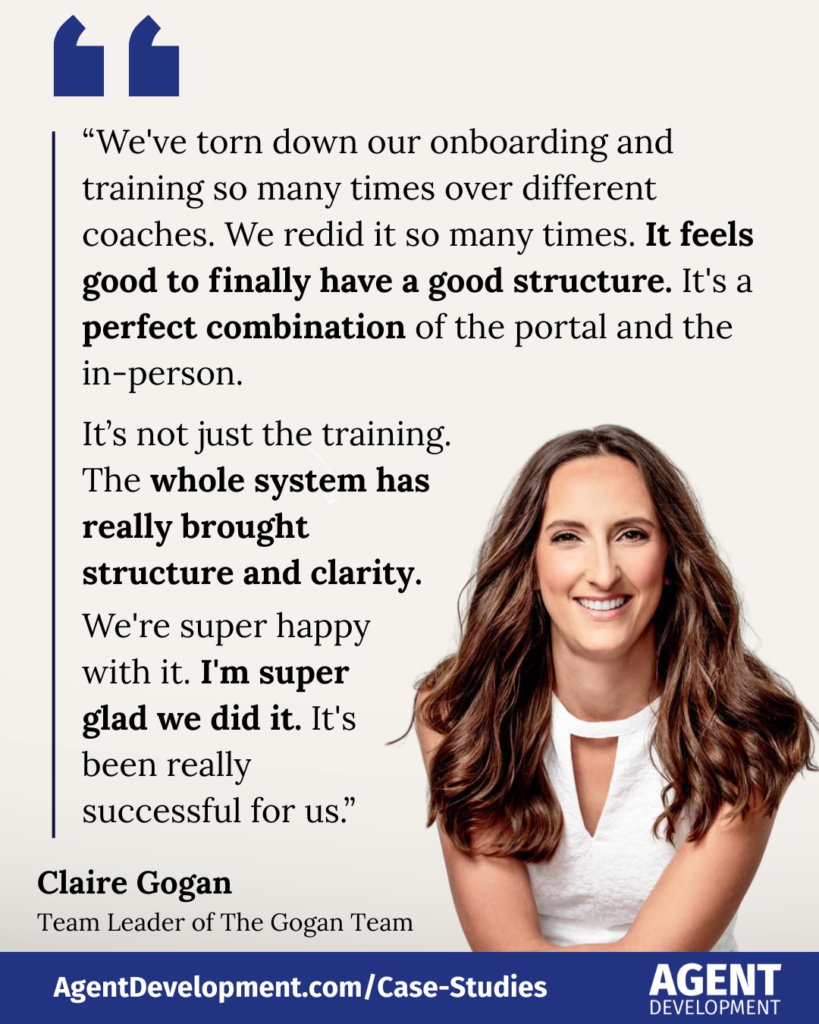
We've torn down our onboarding and training so many times over different coaches. We redid it so many times, swinging the pendulum back and forth. Too much training, not enough, too much. It feels good to finally have a good structure.
What seals it for them is the balance the system strikes, enough independence to build resourcefulness, enough in-person work to keep agents supported and engaged.
It's a perfect combination of the portal and the in-person. They have to do work on their own and have that resourcefulness, but they get enough in person too. We're super happy with it. I'm super glad we did it. It's been really successful for us.
Ready to Build a System That Scales?
The turning point is only a discovery call away. Not because mastery came fast. Because the guesswork is gone.
Book a discovery call to see how the Performance-Based Agent Development System works and how to implement it in your business.
Category:
Tag: